
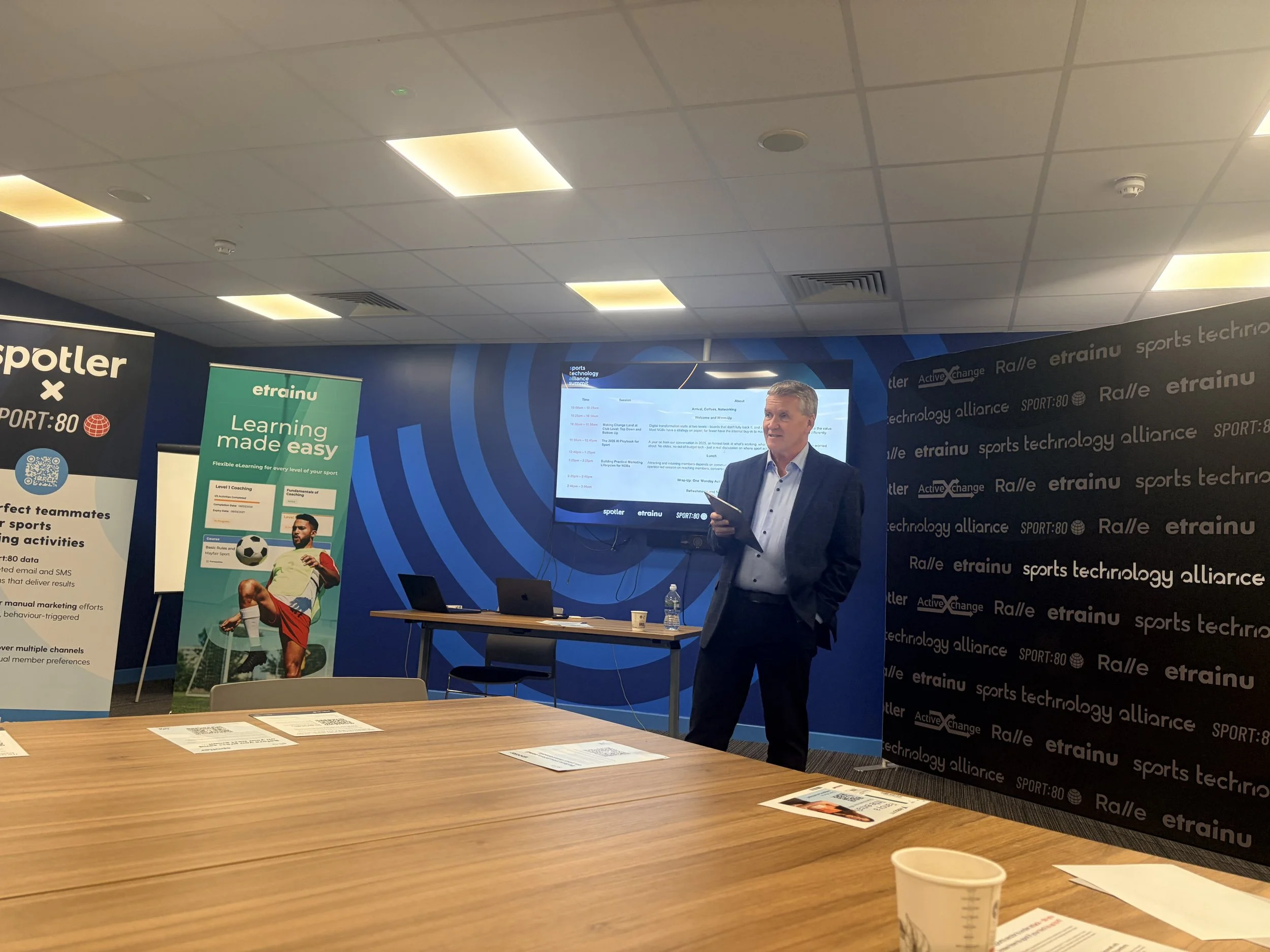
The second STA Dublin Summit came and went, and if you were in the room, you already know it was a good one.
Leaders from across Irish sport gathered at the Sport Ireland Campus in Blanchardstown for a day of honest conversations, practical sessions, and the kind of peer-to-peer energy that only comes from putting the right people in a room together.
The theme for the day was ‘Where Strategy Gets Stuck: Making Change Land.’ No polished success stories, no glossy case studies - just senior leaders working through shared problems with honesty and a genuine willingness to help each other move forward.
Rob Hartnett held the day together as MC with real skill - keeping the energy up, the room engaged, and finding time to pursue his mission to secure a complimentary set of salt and pepper shakers.
A huge thank you to Sport Ireland for hosting us at the Campus and giving us a brilliant setting for the day.
Session 1 - Making Change Land at Club Level: Top-Down and Bottom-Up
Ben Wells, PTI Digital
Ben Wells opened the day with a challenge to the room. PTI’s Sports Leadership Benchmark Report tells a story the sector needs to hear more honestly: only 14% of UK and Irish rights holders can extract meaningful insights from their data, and 32% are monetising 10% or less of their database. The problem has never been a lack of data collection. It’s a lack of strategic intent around what that data is actually for.
Ben was equally direct on AI: 81% of organisations are now using it in some form, but only 2% have an AI strategy, and 63% haven’t updated their data policies to account for it. The gap between adoption and governance is widening. His advice: fix the foundations first. AI amplifies whatever you give it - if the data infrastructure is broken, AI gives you faster, more confident wrong answers.
The table discussions that followed surfaced challenges that will feel familiar to most governing bodies in the room. The most commonly cited barrier wasn’t budget or technology - it was fragmentation. Membership systems, booking tools, finance platforms, and communication tools that don’t talk to each other, creating duplication, manual administration, and data that can never be properly joined.
Key takeaways from the room:
Digital transformation stalls at two levels simultaneously — boards that don’t fully back it, and clubs and volunteers who don’t see the value. Both have to be addressed.
Most organisations are spending significant sums on technology without anyone internally who can evaluate whether it’s the right decision. That gap is costing them.
The right order of operations: get the business running efficiently first, then marketing, then customer experience, then revenue growth. Most organisations skip straight to the last step.
Get the strategy right before you spend. Too many organisations charge into systems investment before answering the most basic question: what are we actually trying to achieve?
Session 2 - The 2026 AI Playbook for Sport
Courtney Stuhmcke, etrainu
A year on from the AI conversation at Dublin ‘25, Courtney Stuhmcke brought the room back to an honest question: where are we actually at?
The room’s self-assessment revealed a familiar spread. Some organisations have moved beyond personal-account AI use and established managed tools with clear policies. Most hadn’t fully caught up, and several acknowledged that the gap between what leadership thinks is happening and what staff are actually doing is significant. That gap - rather than any particular tool or use case - was identified as the real risk.
The governance thread ran through the entire session and generated the most candid exchanges of the day. The core risk: when staff use consumer AI tools with organisational data (member information, safeguarding records, internal documents), that data can be ingested by the platform’s training systems. One delegate raised a subtler but equally important point: even when source systems have proper access controls, data can still leak through temporary files created as part of an AI-assisted workflow.
Key takeaways from the room:
AI adoption is a literacy challenge before it’s a tools challenge. A short, usable policy that people actually read is more valuable than a comprehensive document that sits in a shared drive.
The 20-60-20 model resonated: 20% human thinking up front, 60% AI doing the work, 20% human review at the end. The risk is that the 20% at the end expands until it swallows the time saved in the middle.
The most practical near-term use cases: proofreading and content drafting, inbox triage, updating learning materials, and using AI to write integration scripts between siloed systems.
The best organisations are using AI to free people from tasks that consume time without requiring judgment — so judgment can go where it’s actually needed.
Session 3 - Building Practical Marketing Lifecycles for NGBs
Jack Clay, Director of Customer Experience, Spotler
Jack Clay opened with a show of hands: how many of you send a welcome email when someone becomes a member? Most hands went up. How many of you still know what that member is doing 90 days later? Almost none stayed up. That gap - between the moment someone joins and the moment they feel genuinely connected - is where most organisations lose people.
The session built a lifecycle communications framework around four key stages: prospects, new members, event participation, and qualification and membership renewal. Jack’s central point was straightforward: these journeys don’t need to be complicated. They just need to exist. The marginal gains from adding personalisation on top of a functioning basic journey are small compared to the uplift of simply having one in place at all.
The table discussions surfaced consistent blockers. System fragmentation - registration systems, membership databases, and email platforms that don’t talk to each other - was the most common barrier. The club layer added another layer of complexity: in many sports, the NGB doesn’t have a direct relationship with a significant proportion of its members, and non-member participation happening at club level is a significant blind spot.
Key takeaways from the room:
Most NGBs sit in one of two camps: sending everything to everyone, or avoiding contact until they have to. Both have the same outcome - members drift and renewal rates suffer.
Start renewal communications earlier than feels comfortable. By the time a membership has lapsed, re-engagement costs significantly more than retention would have.
Email open rates are an increasingly unreliable metric. Track downstream actions instead: did they show up within 30 days? Did they renew on time?
Start with one journey. Build the onboarding sequence, get it running, and let everything else follow from there.
Events like this only work because of the people who show up ready to be honest.
Organisations from across Irish sport, senior leaders sharing what’s broken as freely as what’s working, and a genuine collective willingness to help each other move forward. That’s not something you can manufacture.
What’s Next?
We’re already looking ahead. Details of the next STA Summit will be announced soon, and alongside our in-person events, we’re continuing to build out the STA’s webinar programme - more ways to keep the conversations going between events.
Watch this space.
To find out more or get involved, get in touch at info@sportstechnologyalliance.com.